Approved to Deploy, Not Ready to Own
1. A sixty-five-year-old warning arrives in the CMDB
In 1960, Norbert Wiener — the founder of cybernetics — wrote down the operating condition for handing decisions to a machine:
"If we use, to achieve our purposes, a mechanical agency with whose operation we cannot efficiently interfere once we have started it, because the action is so fast and irrevocable that we have not the data to intervene before the action is complete, then we had better be quite sure that the purpose put into the machine is the purpose which we really desire."1
For decades that read as philosophy. It is now a line item on a deployment checklist, and it has arrived in CMDB work. The judgment calls a companion paper described — which identifiers establish identity, which source owns which attribute, what class a device belongs to, what happens to the records that don't clear the bar — are increasingly authored by automation rather than by a person in a workshop. An AI author can propose precedence rules, classification mappings, and identity thresholds faster than any human team, and it can propose them again every night.
Wiener's condition splits the question most organizations are asking into two. Deployment readiness asks: can this author run? Operational readiness asks: can you efficiently interfere once it does — can you still own, and still change, what it decides? Most estates preparing to put an AI author into production have answered the first question thoroughly and the second not at all.
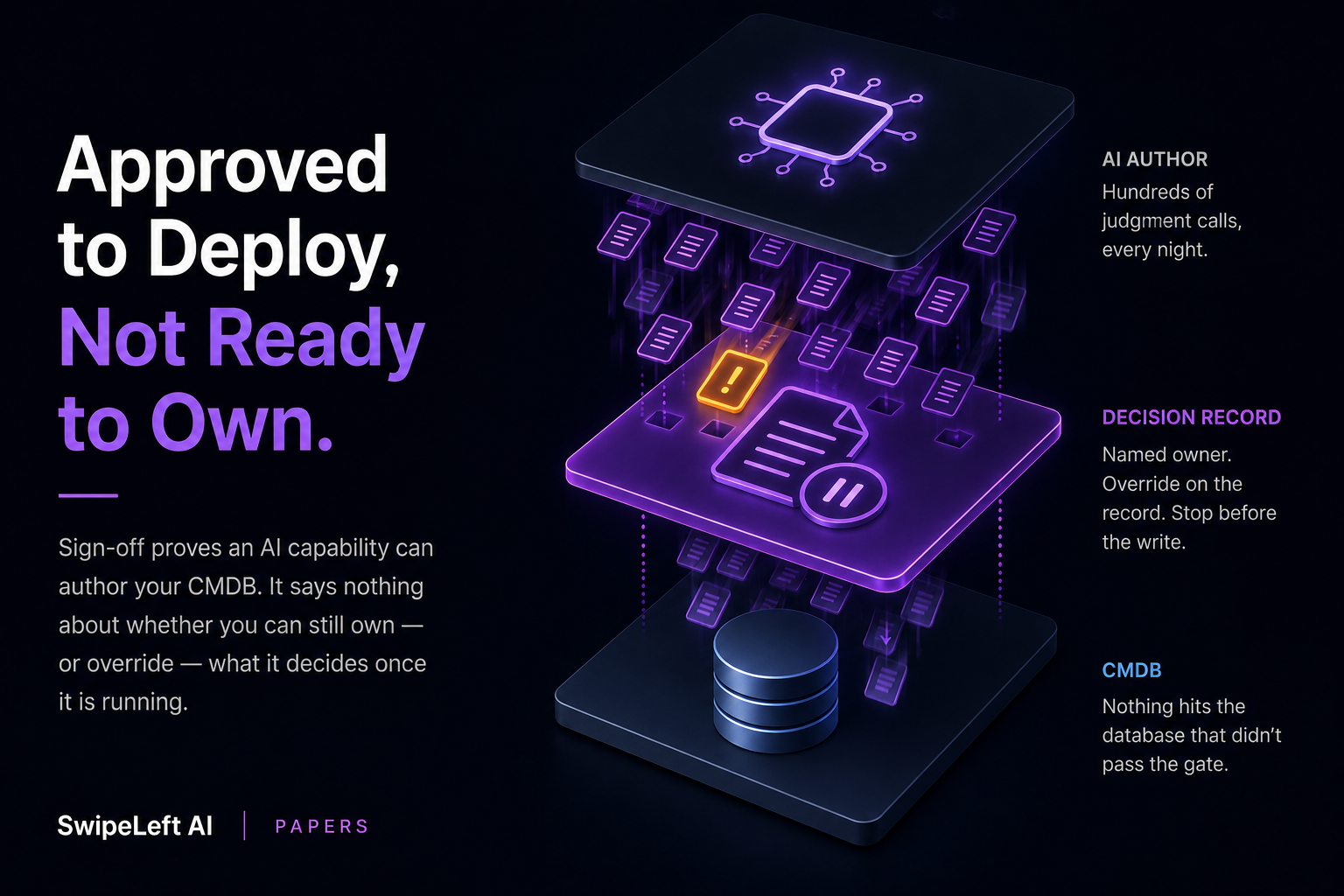
This paper is about the second question. It takes the discipline of the first paper as given — that judgment calls belong on a record — and makes one claim beyond it: at machine speed, the decision record stops being documentation and becomes the control surface. A record that names the decision, its author, its evidence, and its revision path is the mechanism by which a human owner can reach a machine author at all. Call that property executable ownership — ownership that can actually be exercised, not merely asserted on an org chart. The rest of this paper is about what it takes to have it.
2. Approval proves permission, not readiness
Software engineering learned long ago that a green result proves less than it seems to. "Program testing can be used to show the presence of bugs, but never to show their absence!" — Dijkstra's corollary is fifty-five years old.2 A sign-off has the same shape. It shows the capability ran — once, on the data present that day, with the people present that day. It cannot show the absence of the operational gaps that surface later: who owns the outcome, who monitors quality, who intervenes when the recommendations drift. A governance practice writing on IT service management puts the distinction in one line: "Approval is not evidence. It is a decision."3 A body agreed to proceed. That is all a sign-off records.
Watch the gap open on an estate that proved the first readiness and assumed the second. An AI-assisted onboarding reconciles six discovery sources into a clean import. The disposition report is green. The review board signs off. The engagement closes — and the author keeps running, because that was the point. Months later a nightly run proposes a precedence change that hands the endpoint tool ownership of a field it never owned before; a class of devices shifts with it; a change request routes on the new class; and at two in the morning a device that should have waited for a maintenance window reboots under load. The incident bridge can answer what changed in forensic detail — the log is immaculate. The question that empties the room is different: who can suspend the nightly author, and how, and has anyone ever tried?
The industry that runs the world's largest services has already institutionalized this split. At Google, a service does not receive SRE support because it launched; it passes a Production Readiness Review — a separate assessment, with its own criteria, conducted by the people who will carry the pager — precisely because launching a service and being ready to operate it are different achievements.4 Deployment readiness is demonstrated at a moment. Operational readiness has to hold under pressure, months later, when the person who ran the onboarding is gone.
3. Recognition is not control
The most seductive mistake in AI governance is to solve the wrong half of the problem. Enormous effort goes into making AI visible — explainability, decision logs, monitoring dashboards, an audit trail of what the model did and why. All of it is valuable. None of it, by itself, is control. The same practice draws the line cleanly: "Recognition creates awareness. Control requires decision authority."5 You can see everything an AI author did and still be unable to change any of it.
The distinction is between two states that look identical from a distance. A decision — like a risk — can be visible: everyone can see it. Or it can be owned: someone is required to make a call about it and is accountable for the outcome. Most organizations operate in the first state and assume it produces the second. It does not. A transparent AI that logs every precedence rule it authors is operating in the first state. Whether anyone owns those rules is a separate question, and transparency does not answer it.
On a CMDB the test turns concrete. It is not can you see what the AI classified? — a good system can always show you that. It is the enforcement question: show me the point where a decision you disagree with is stopped before it becomes a CI in your instance. If there is no such gate — if the author's output flows to the platform and the only recourse is to clean it up afterward — then the AI is visible but not governed, and the estate is back in the archaeology it was trying to escape. Control exists only where intervention does. This is Wiener's "efficiently interfere," made into a deployment rule: an author with no human override path has no business with production access.6
4. At machine speed, the gap stops being theoretical
For as long as the author was human, an estate could get away with never answering these questions. A consultant onboarding a source made a handful of precedence calls a week — slowly enough that ownership could be improvised in a thread, a workshop, the memory of whoever was in the room. The ambiguity was real, but it moved slowly enough to survive.
An AI author removes that slack. It makes hundreds of judgment calls in a single run and can make them again the next night. And here the oldest finding in automation research applies without modification. In 1983, writing about process plants and flight decks, Lisanne Bainbridge named the central irony of the field: "the more advanced a control system is, so the more crucial may be the contribution of the human operator."7 Automating the authoring did not remove the human from the loop. It concentrated everything that remains — ownership, override, escalation — into the moments where the human touches the system, and made the design of those moments the most important design problem in the deployment.
The important claim is that the AI is not the source of the problem. "AI does not introduce ambiguity. It scales whatever ambiguity already exists."8 An estate that never really decided who owns the operating-system field, or what confidence clears the bar for import, did not have that gap created by the author — it had it revealed, and amplified, by something fast enough to make the omission expensive. Worse, the exposure is quiet: the estate grows more dependent on the author while believing it has grown more capable, and the gap goes unnoticed until an incident forces it into view.
This sets an honest limit on what any product — ServiceMatch included — can claim. A platform cannot manufacture ownership; where decision authority is unclear, better tooling only surfaces the ambiguity more efficiently.5 What a platform can do is give the decisions a governed place to live, so that a named owner is able to exercise authority over them — which is exactly what a fast author makes indispensable, and exactly what the first paper's decision record was for. This is the claim from section 1, now with its mechanism visible: when the author makes hundreds of calls a night, the record is the only surface on which a human owner can meet it. Ownership that is not executable on a record is, at machine speed, not ownership.
5. The readiness questions, asked of an AI author
Strip the topic of its novelty and a durable checklist remains — six questions an organization should be able to answer before an AI capability enters live service.9 They are not AI questions; they are the operational questions any capability has always had to answer, now pointed at a machine that writes configuration:
- Ownership — if the AI-authored configuration contributes to a material consequence — a device in the wrong class that misroutes a change, a precedence rule that hands the wrong source authority over an identifier — who owns that outcome?
- Authority — who can stop, override, or suspend the author? Is that authority real, and has it ever been exercised?
- Monitoring — what signals indicate the decisions are healthy, and what signals indicate degradation? Is anyone watching decision quality, or only export counts?
- Intervention — how is an action challenged, reversed, or paused — before it lands in the instance, not after?
- Escalation — when confidence drops, who decides? Does a low-confidence record wait for that decision, or flow through anyway?
- Evidence — what evidence supports operation today, and what evidence would suspend it tomorrow?
The compressed version of all six is older than software. Admiral Hyman Rickover, who ran the naval reactors program for three decades, gave Congress the diagnostic in 1961: "Unless you can point your finger at the man who is responsible when something goes wrong, then you have never had anyone really responsible."10 Point the finger at a CMDB: if the AI-authored configuration produces a wrong CI tomorrow, and it drives a bad change or a missed incident, at whom do you point — and can they show, as a lookup rather than an archaeology project, why the configuration was shaped that way? If the answer is unclear, readiness has not been demonstrated. The issue is not the model's quality. It is operational ownership.
The software industry has already run this experiment once. When Amazon dismantled the wall between building services and operating them, Werner Vogels compressed the result into six words: "You build it, you run it."11 Ownership follows the author. An AI that authors configuration does not repeal the rule; it sharpens it, because the you can no longer be the author itself. Someone human runs what the machine builds — or no one does.
None of this is a private doctrine. NIST's AI Risk Management Framework makes governance a cross-cutting function that spans the system's whole lifecycle, not a gate passed at deployment.12 ISO/IEC 42001 casts AI governance as a management system — something an organization operates continually, not a review it schedules once.13 And for anyone who runs a CMDB, the vocabulary is not foreign at all: it is change enablement, service transition, and operational governance, arriving at the doorstep of the configuration data those practices depend on.
6. One implementation
One implementation of this readiness model is ServiceMatch, offered here as an existence proof that the questions can be answered in a running system — not as the point of the paper.
ServiceMatch is a governed conditioning layer for CMDB discovery data, and its AI layer authors configuration the way this paper argues an author should: nothing it produces reaches the instance except as an explicit, attributable, overridable decision. Read down the six readiness questions and the design answers each one deliberately.
| Readiness question | What it requires | How ServiceMatch answers it |
|---|---|---|
| Ownership | A named owner of the outcome | Every decision is attributed to its author and becomes effective only through operator review; there is no path by which the author's output becomes effective without a named reviewer |
| Authority | Someone who can stop, override, reverse | Operator overrides are first-class records that take precedence and survive re-runs; destructive actions require explicit confirmation; the author has no write-around path |
| Monitoring | Signals of decision quality, not just throughput | Identity scoring, coverage decomposition, and a calibration gate watch whether decisions are sound — not merely whether records moved |
| Intervention | A gate before consequences | Output is conditioned input to identification and reconciliation, never a direct table load; low-confidence records are blocked with a stated reason before they can become CIs |
| Escalation | A defined path when confidence drops | Records score 0–100; those that don't clear the bar are held for review rather than imported, and in unattended operation the author writes proposals as pending, never as irreversible action |
| Evidence | A standing record that explains the estate | The decision record: what was decided, by whom, on what evidence, against which alternatives, and how to revise it — queryable long after the engagement closes |
Two qualifications keep the claim honest. First, consistent with the limit above, ServiceMatch does not manufacture an operating model; it gives decisions a governed place to live so that a named owner can actually exercise authority over them. The ownership is the organization's — the system makes it executable. Second, the AI authoring is held to the same evidence bar as any author: on a reference estate, configuration authored by the AI landed within ±5% of a baseline hand-curated by an expert, and an authoring engine does not ship until validation shows zero false confirmations against its evaluation corpus. The human stays in the loop by design — author, then review, then effective — and even in daily unattended operation the system proposes rather than commits.
Deployment matches the argument. ServiceMatch runs single-tenant, in the environment where the engagement lives; discovery data never leaves the organization's control. And everything it produces is designed to enter the instance as conditioned input to identification and reconciliation, not as a direct table load — so the gate the argument demands sits where it belongs, before the write.
7. Readiness is a standing property, not a gate
The temptation is to treat readiness as something proven once, at go-live, and then filed. Eisenhower's soldiers' proverb applies: "Plans are worthless, but planning is everything."14 The readiness assessment is the plan — a photograph of a moving system, obsolete the day the estate onboards its next source, reshapes a feed, or upgrades the model behind its author. The planning is the standing capability the photograph was supposed to certify: a named owner who can still reach the decisions, a gate that still stops consequences, a record still cheap enough to consult. The service-management phrase for the same split: "Go-live is an event. Operational readiness is a capability."15
Which is why the discipline this paper argues for in the CMDB, and the discipline the operations literature has described for forty years, are the same one under two names: keep the decisions on a record, keep a named owner able to reach them, keep the gate where consequences are stopped before they occur. Do that and an AI author is an accelerant. Skip it and the author simply reveals, faster than any human could, that the estate was never able to explain itself.
The real question was never whether an AI could author your CMDB. It can, and increasingly it will. The question is whether, a year from now, you can still answer for what it did — and change it. Approval cannot demonstrate that.
Only ownership can, and only on the record.
At machine speed, ownership has to be executable.
ServiceMatch, by SwipeLeft AI, is a governed conditioning layer for CMDB discovery data. Its companion paper, "The Decisions IRE Can't Make for You," argues for treating CMDB judgment calls as governed objects; this paper extends that argument to the moment those judgments are authored by AI. Both are published, with the policies behind them, at swipeleft.ai/servicematch/positions.
Sources
-
Norbert Wiener, "Some Moral and Technical Consequences of Automation," Science 131 (1960) ↩
-
Edsger W. Dijkstra, "Notes on Structured Programming" (EWD249, 1970) ↩
-
Google, Site Reliability Engineering, "The Evolving SRE Engagement Model" (2016) ↩
-
Recognition Is Not Control: Known Risks Become Failures ↩ ↩2
-
Human Override Authority: The Missing Control in AI Governance ↩
-
Lisanne Bainbridge, "Ironies of Automation," Automatica 19:6 (1983) ↩
-
The six-question framing is adapted from The Missing Layer in Enterprise AI: Operational Readiness ↩
-
Werner Vogels, "A Conversation with Werner Vogels," ACM Queue 4:4 (2006) ↩
-
NIST, Artificial Intelligence Risk Management Framework (AI RMF 1.0, 2023) ↩
-
ISO/IEC 42001:2023, Artificial intelligence management system ↩
-
Dwight D. Eisenhower, remarks, National Defense Executive Reserve Conference (November 14, 1957) ↩